Early Days in the High Country
Cradled between Mount Jefferson and Paddy Mountain in the Blue Ridge Mountains of northwest North Carolina, today's West Jefferson began as Cherokee hunting ground and frontier wilderness. Ashe County was founded in 1799, and a year later the county seat — Jeffersonton, later Jefferson — became the first U.S. town named for Thomas Jefferson. Settlers farmed, logged, and hunted amid steep ridges and the cool upper reaches of the New River valley.
Among the earliest landholders was Revolutionary War hero Colonel Benjamin Cleveland, whose 1779 grants laid groundwork for future communities. Mount Jefferson was then known as “Panther Mountain,” a wild refuge of frontier lore. Through the 1800s these mountains forged a self-reliant culture of blacksmiths, farmers, and traders whose heritage still defines Ashe County life.
Rails, Timber, and Growth
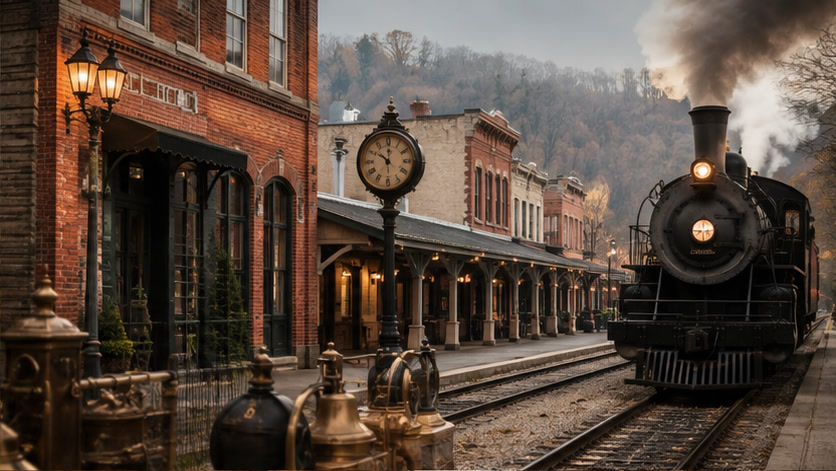
Modern West Jefferson rose after the Virginia-Carolina Railroad — later Norfolk & Western — pushed across Ashe County in 1914–1915. When tracks bypassed Jefferson, shops clustered beside the line and the town incorporated on February 9, 1915. The daily Virginia Creeper train linked the region to Virginia markets, carrying lumber, bark, iron, and mountain goods while bringing passengers and supplies the county had never seen.
The railroad transformed the economy. Sawmills, banks, and the stately West Jefferson Hotel appeared along bustling Jefferson Avenue. By 1920 the once-remote valley had become a classic Appalachian boomtown, connecting Ashe County's rugged timber lands with the wider world and ushering in an era of prosperity.
Cheese, Community, and Culture
Industry soon gave way to hometown enterprise. In 1930, Kraft-Phoenix opened Ashe County Cheese — North Carolina's oldest cheese plant, still operating in the historic district today. Downtown filled with barbers, cafés, and tobacco warehouses, while Saturday “market days” echoed with fiddles and friendly chatter. The town became the retail center of the high country and the social heart of Ashe County.
The legendary Virginia Creeper became a symbol of connection and nostalgia. Locals recall riding its coaches to Virginia or greeting soldiers returning from World War II. Its whistle remains one of the enduring sounds of mountain memory.
From Decline to Arts Revival
By mid-century the timber boom faded and the railroad ceased service in 1977. Yet West Jefferson rebounded through the craftsmanship and creativity of its people. Revitalization efforts in the 1990s restored the historic downtown, turning brick façades into the celebrated Arts District filled with studios, murals, and mountain music.
Today festivals such as the Christmas in July Festival draw thousands, while restored landmarks like the Parkway Theater and Ashe County Cheese showcase proud heritage. Along the nearby Blue Ridge Parkway, visitors find small-town charm blended with vibrant culture and genuine hospitality.
Neighboring Towns and Artistic Legacy
Jefferson remains the serene county seat with its 1904 courthouse and the Museum of Ashe County History. To the north, Lansing grew around the same rail line and became a hub for timber and small-scale industry. To the southeast, Glendale Springs flourished around mineral springs and today welcomes travelers to the historic inn and the famed Ben Long frescoes — masterpieces that draw art lovers from around the world.
A Living Mountain Story
Together these communities tell the story of resilience and creativity in North Carolina's High Country. From frontier beginnings to railroads and renaissance, every mural, trail, and melody retells their journey. Visitors can explore galleries, ride the Blue Ridge Parkway, or simply relax on a porch and feel the mountain spirit that has shaped Ashe County for more than two centuries.
Why We Built High Peak Here
We came to West Jefferson because of the walkable downtown, slower pace, mountains in every direction. High Peak is four modern A-frames two blocks from Jefferson Avenue — four personalities, one genuine West Jefferson welcome — with mountain views, a hot tub at every cabin, and a five-minute walk to shops, galleries, and restaurants. Choose the story that speaks to you, then step outside and experience the real thing.
Compare the cabins